
Research
The Alfredo DW-TAPS Research work on a broad set of topics that all support the provision of safe drinking water. Several are featured below.
Activated Carbon Block POU Filters
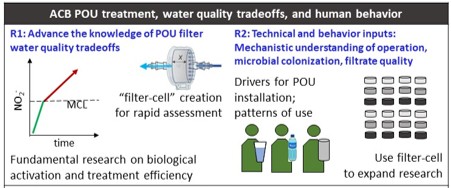
In the United States, many homes use carbon-based point-of-use filters to improve drinking water —whether in the fridge, under the sink, or attached to the faucet. These filters are especially common in cities with lead problems, in rural areas with private wells, and among people who prefer to not drink tap water. But while these filters are popular, scientists still do not fully understand how they affect water quality over time. In some cases, the filters may even make water worse, increasing the concentrations of contaminants, like nitrite, to unsafe levels. This research aims to understand how the design of the filters and how they are used can impact the quality of household water. Results from this research can improve the safety of filtered water. The researchers will work closely with local community members to communicate results to the public. Supported by NSF Grant# 2520301.
Drinking Water Risk, Perception, and Trust
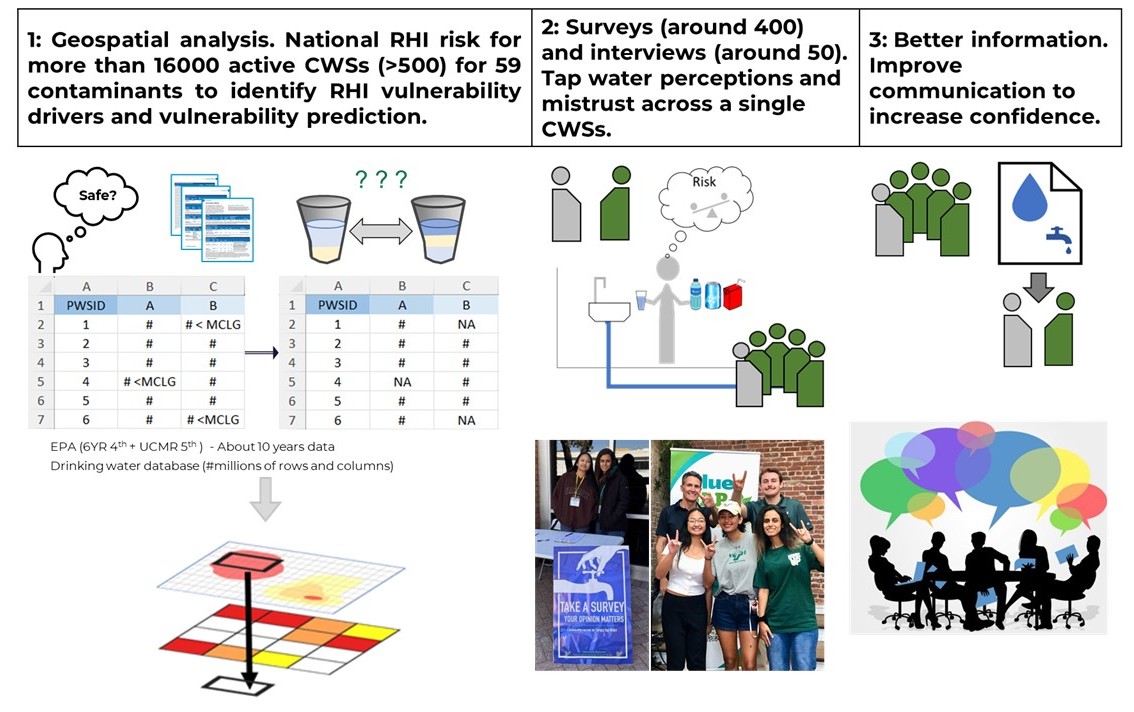
Despite federal initiatives such as the Infrastructure Bill to address sub-par drinking water concerns across the U.S., we still currently lack a consistent metric to compare the cumulative relative health risk associated with drinking a glass of water in one location with that in another. For a long time, regulators have monitored U.S. drinking water delivery systems based on the number of violations of an individual contaminant. This focus on the history of contaminant-specific violation counts ignores the overall health burden from concurrent exposures to multiple chemicals. This research builds on the previous work creating a Relative Health Index (RHI), a cumulative risk metric that encapsulates cancer and non-cancer toxicity values, exposure concentrations, and severity scores, and applies this metric to over 30,000 Community Water Systems (CWSs) in the United States. The investigation includes CWS contaminant violation experience from 1982 to 2023 and over a decade of RHI calculations based on occurrence of contaminants.
Rethinking Biofiltration

Micropollutants (MPs) such as 1,4‑dioxane and acetaminophen persist in drinking water because they occur at trace concentrations, resist biodegradation, and compete with abundant natural organic matter. Biological activated carbon (BAC) filters offer a promising, energy‑efficient treatment pathway, yet existing designs emphasize minimizing clogging and maximizing removal of bulk total organic carbon (TOC), not optimizing the biofilm properties that govern MP degradation. A critical gap remains in understanding how biofilm thickness, density, and microbial stratification influence biodegradation and biosorption of recalcitrant compounds, particularly under authentic drinking water conditions. We are generating foundational knowledge linking biofilm structure to contaminant treatability and create a novel modeling framework capable of capturing complex, system‑specific biofiltration dynamics.
Aluminum Dissolution and Faradaic Efficiency in Electrocoagulation Systems
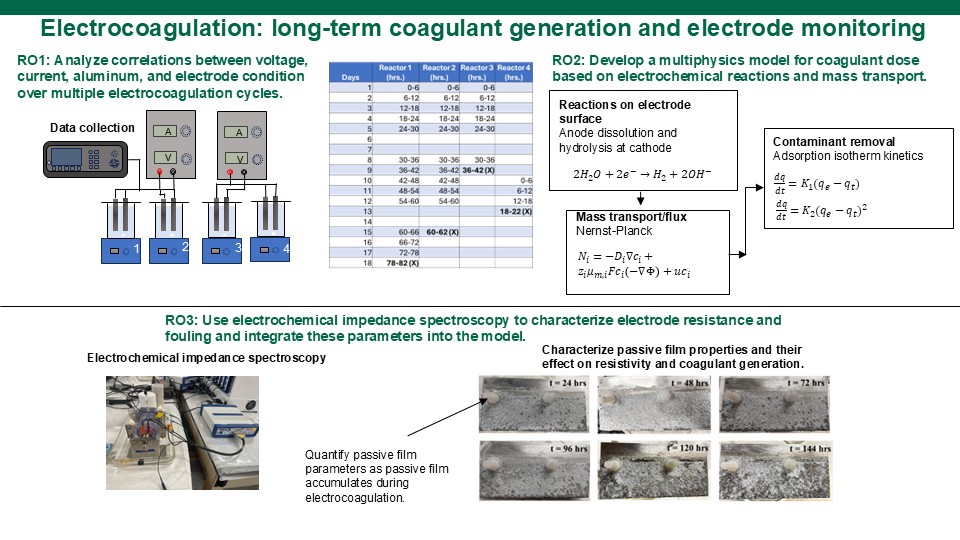
The primary objective of this study is to improve understanding of dissolution behavior and Faradaic efficiency in Al-EC systems to inform predictions of long-term aluminum coagulant formation. In this context, long-term refers to an experiment repeated over several batches with the same electrodes, since most Al-EC studies have been conducted with new electrodes. A bench-scale reactor operates for 80 hours at a constant voltage of 12 V using two electrolyte compositions containing chloride ions, representative of surface and groundwater. Aluminum concentration, electrode mass loss, pitting volume, and passive film composition are quantified at 20-hour intervals to evaluate the effect of plate condition on coagulant generation. This work aims to improve understanding of super-Faradaic behavior in Al-EC, for which reported behavior varies widely across studies, with the novel contribution of evaluating this performance metric on a longer time scale with repeated-use electrodes.
Our records show you have water, do you?

In rural communities in Maharashtra and West Bengal, India (and many LMIC communities), seasonal, social, and environmental disruptions invariably impact use, management, and financial support of community centered water technology; yet, these links to water technology sustainability and time to failure remain largely unexplored. This research explores the concept of access in Maharashtra using a database we built for all the electrocoagulation defluoridation units installed on record and the timeline of use and accessibility we constructed from semi-structured interviews with local operators. In West Bengal we explore the concept of access through the Jal Jeevan Mission’s dashboard and semi-regular water perception surveys administered by an NGO. In many communities, 100% tap access is displayed on the dashboard, but the reality on the ground is very different. Together, these two projects explore the concept of “access” in select communities in India that are confronted with geogenic water contamination.
Policy Analyses Using SDWA data

Our research efforts have created many unique databases ranging from information on arsenic demonstration sites to utility rates data, each linked to the Safe Drinking Water Information System database, linking all parameters to unique public water system IDs (PWSIDs). Using these databases, we have conducted research such as the first arsenic treatment systems, estimated the cost of compliance nationally, evaluated rate changes in the face of major economic shocks (recessions), and evaluate current and pending policy decisions. We continue to publish our results, becoming a leading research group on US policy analyses.
Funding
Funding for our research includes federal, state, NGO, Dr. Alfredo's career fellowships, and foundation funding. Please see Dr. Alfredo's CV for a full list of funding sources.